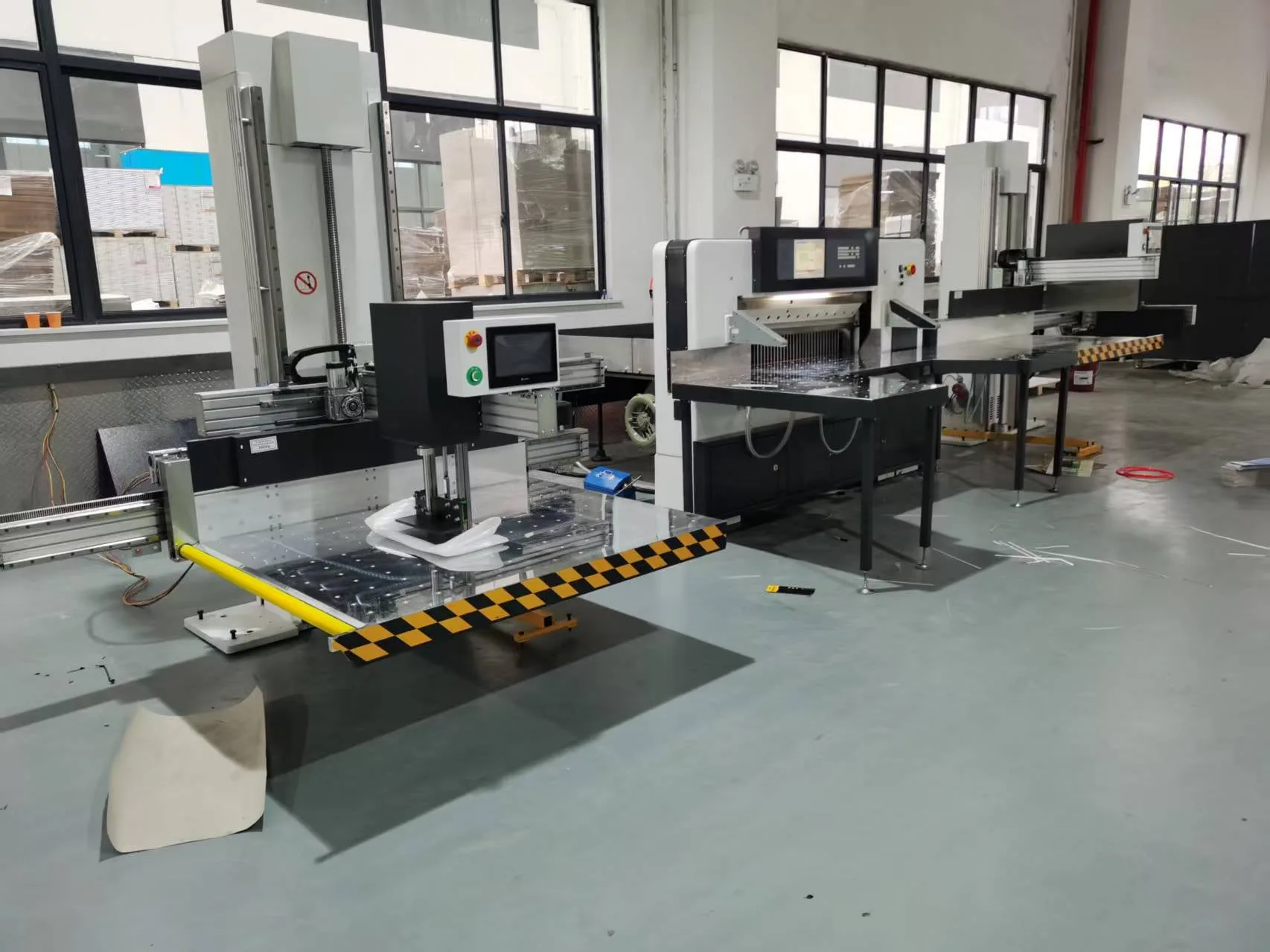
Cutting Line vs Standalone Guillotine: Which Should a Plant Buy?
The choice between a standalone guillotine and a cutting line is a workflow decision. A line may reduce handling between operations, but it also adds coordination, footprint and commissioning requirements. A standalone machine may offer more flexibility when jobs change frequently or when the upstream and downstream equipment is not standardized.
When a standalone machine is the better fit
Choose a standalone guillotine when the plant has varied job sizes, several material types or a changing mix of upstream suppliers. It is easier to schedule independently, move between product families and keep running when another process is stopped.
A machine such as QZK920 can suit compact mixed-work rooms. QZK1370C is more appropriate when a standalone cutter must accept larger packaging formats or repeat programs. The buyer should still plan pallet movement, staging space and operator loading time.
When a line earns its footprint
A line becomes attractive when the same material path repeats at meaningful volume and manual transfer is a measurable bottleneck. Benefits may include fewer handling steps, more consistent sequencing, reduced intermediate storage and clearer production tracking.
The business case should use measured minutes per job. Count loading, alignment, transfer, waiting, re-stacking, inspection and changeover. A line that removes only one visible movement may not justify its additional capital or maintenance burden.
Questions before choosing a cutting linkage line
For a cutting linkage line proposal, ask for a complete layout with infeed and outfeed direction, operator positions, guarding, service access, utilities, controls and emergency-stop zones. Confirm how the line behaves when one module is offline and whether production can continue in a reduced mode.
Also define material flow: pallet dimensions, maximum load, buffer capacity, reject handling and finished-stack removal. These practical details often determine whether the promised throughput is achievable.
Compare total project risk
A standalone cutter concentrates risk in one machine. A line adds interface risk between modules, software or controls, commissioning and operator training. Request a responsibility matrix, FAT plan, site acceptance criteria, spare-parts list and escalation contact for each subsystem.
Decision checklist
- Measure manual handling and waiting time for representative jobs.
- Confirm whether the job mix is stable enough for a line.
- Draw the actual floor layout, utilities and material path.
- Define reduced-mode operation and service access.
- Compare labor savings with commissioning and maintenance cost.
Next step
Send Luolan Machinery your process sequence, job frequency, floor plan and target volume. The team can assess a standalone QZK920 or QZK1370C against a QZK1300 line concept.