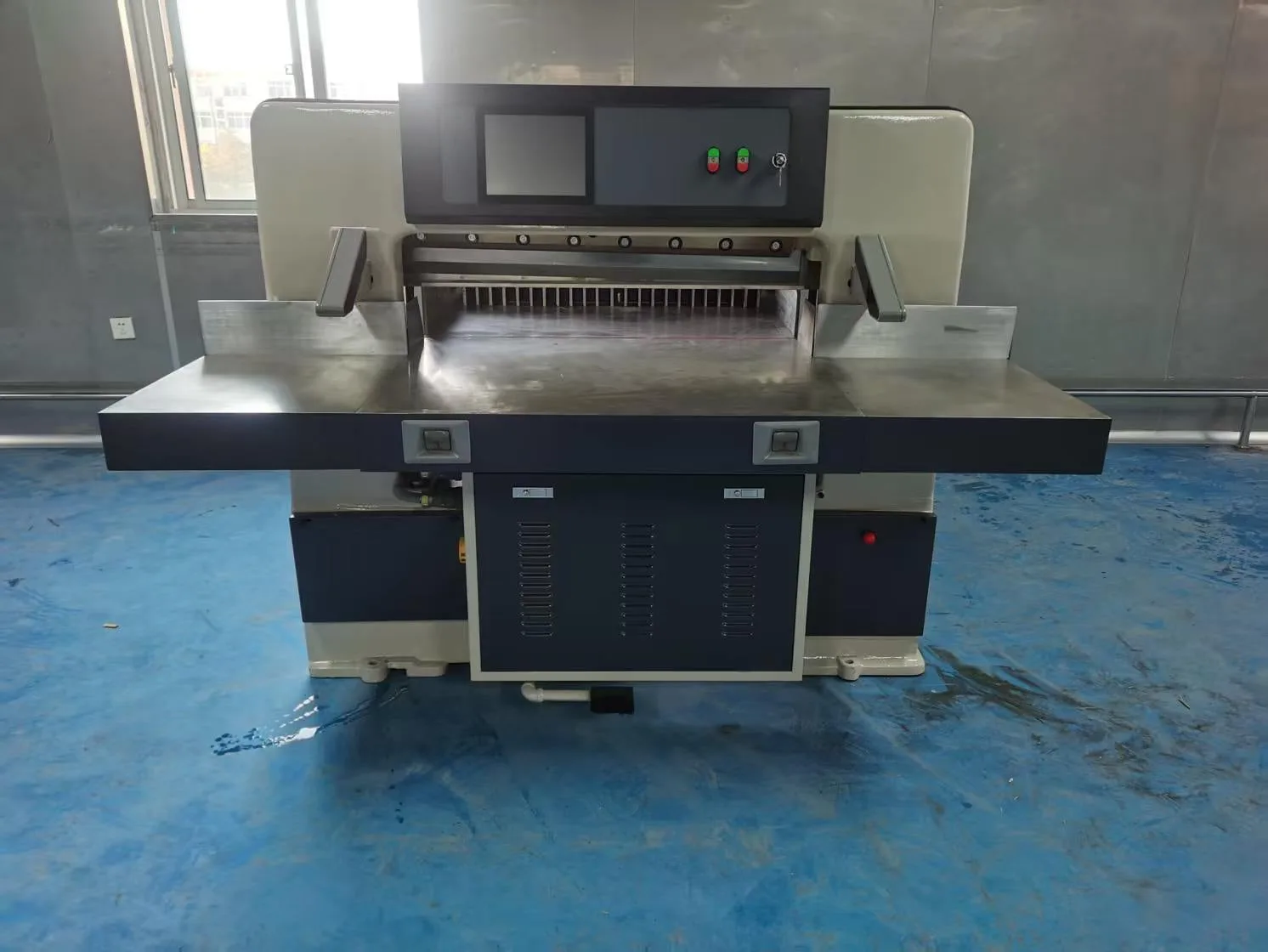
How to Choose a Paper Cutting Machine for Printing and Packaging Plants
Choosing a paper cutting machine is one of the highest-impact capital decisions in a printing or packaging plant. The wrong size or control system can create bottlenecks, scrap, and operator fatigue; the right machine improves trim accuracy, throughput, and safety for years.
This guide is written for buyers, plant managers, and procurement teams who need a clear decision framework—not a brochure.
1. Start with your real cutting jobs
Before comparing models, list the jobs that will run on the cutter every week:
- Maximum sheet size (after printing or converting)
- Typical and peak stack heights
- Material mix (coated paper, board, labels, soft packaging substrates)
- Accuracy tolerance your QC team actually enforces
- Shift pattern (single shift vs continuous production)
If most work fits within a smaller format, a 920 mm class cutter can be the better ROI. If you regularly handle larger formats or want headroom for growth, a 1370 mm class machine is usually safer.
2. Cutting width: 920 mm vs 1370 mm
| Buyer priority | Prefer 920 mm class | Prefer 1370 mm class | | --- | --- | --- | | Typical sheet size | Smaller commercial print / office formats | Larger print & packaging formats | | Floor space | Tighter workshops | Plants with dedicated cutting areas | | CapEx focus | Lower entry cost | Higher capacity and versatility | | Growth buffer | Limited | Better long-term flexibility |
A practical rule: buy for today’s peak jobs plus 12–24 months of growth, not for rare oversized sheets that appear once a year.
3. Control system: digital display vs programmable
For many plants, this is the real decision:
- Digital-display hydraulic paper cutters suit teams that need clear readouts, stable hydraulic cutting, and straightforward operation for mixed or lower-program-volume work.
- Programmable hydraulic paper cutters (Luolan QZK920, QZK1300, QZK1370C) suit repeat jobs, stored cutting programs, higher consistency across shifts, and buyers who want to reduce operator variance.
Ask yourself: Do operators re-enter the same cutting sequences every day? If yes, programmable control usually pays back faster.
4. Check hydraulic structure and build quality
Procurement should verify more than catalogue specs:
- Frame rigidity and long-term dimensional stability
- Clamp and knife drive reliability under full load
- Ease of knife change and maintenance access
- Spare-parts availability for hydraulic and electrical components
Industrial cutters are judged after 12–36 months of plant use—not on day-one demo cuts.
5. Safety and compliance for plant buyers
Modern buyers should confirm:
- Two-hand / dual-control operation where required
- Light barriers or equivalent safety devices as applicable
- Emergency stops and clear operator training materials
- Manufacturer quality system (for example ISO-aligned production practice)
Safety is not optional packaging—it is part of total risk and insurance cost.
6. Total cost of ownership (TCO), not only unit price
A cheaper machine can become expensive if it causes:
- Higher waste from inaccurate cuts
- Longer changeovers between jobs
- Frequent unplanned downtime
- Difficult spare-parts lead times for import buyers
Request a clear commercial package: machine configuration, spare parts list, packing/shipping terms, installation guidance, and warranty scope.
7. Buyer shortlist checklist
Use this before issuing a PO:
- Confirm max format and daily volume
- Choose digital-display vs programmable control
- Validate hydraulic capacity and build quality
- Review safety configuration
- Compare TCO and after-sales support
- Ask for references from similar print/packaging plants
Recommended next step
If you are evaluating Luolan Machinery options:
- QZK920 — programmable paper cutter (920 mm) for efficient, accurate daily cutting
- QZK1300 — programmable paper cutter (1300 mm) for medium to large print shops
- QZK1370C — programmable paper cutter (1370 mm) for larger formats and stored programs
- Cutting Linkage Line — loading and unloading line when you need a broader cutting workflow
Contact Luolan Machinery with your sheet sizes, materials, and monthly volume. We can help match the machine class to your plant’s real production—not a generic “best seller.”